
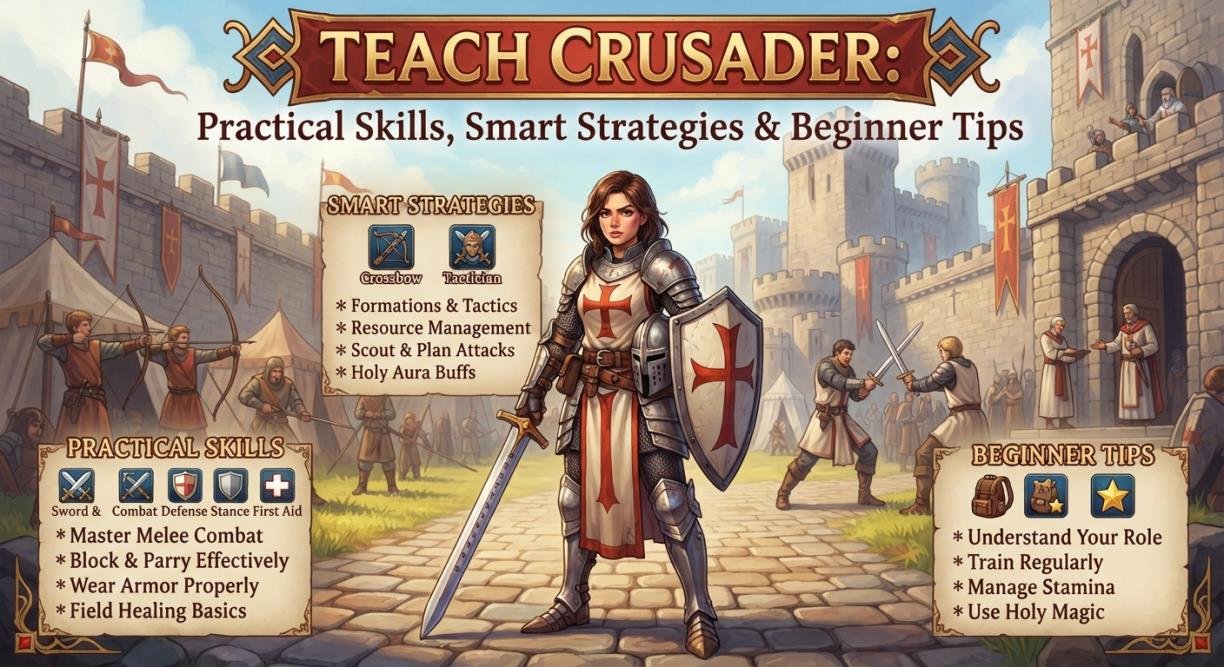
Teach Crusader: Practical Skills, Smart Strategies & Beginner Tips
Teaching Crusader history is not simply about memorizing battles, dates, and famous leaders. For beginners, complex timelines, unfamiliar geography, religious conflicts, political struggles, and competing historical perspectives can make the subject difficult to understand. The solution is to teach the Crusades through a clear, structured approach that connects events with their causes, consequences, people, places, and primary sources.
Teach Crusader provides that practical framework. Designed to make Crusader history easier to understand, more engaging to study, and more meaningful for learners. By combining chronology, geography, major campaigns, key figures, military strategy, and multiple perspectives, it helps students develop genuine historical understanding rather than relying on memorization alone.
What Does “Teach Crusader” Mean?
The phrase “teach crusader” can be interpreted in different ways, but in a historical context it is best understood as teaching about Crusaders, the Crusades, and the societies involved in them. A Crusader was generally a participant in a medieval crusading expedition. The broader term Crusades refers to numerous campaigns associated with the Latin Christian world, particularly those directed toward the eastern Mediterranean.
The movement was not one continuous war, nor were all crusades directed against the same opponents. The First Crusade was launched following Pope Urban II’s call at the Council of Clermont in 1095. Its successful capture of Jerusalem in 1099 contributed to the establishment of several Latin Christian states in the eastern Mediterranean.
Crusader and Crusade Are Not the Same Thing
A useful first lesson is to distinguish the person from the movement. A Crusader can refer to an individual who participated in a crusade, while a Crusade refers to a particular military expedition or, in broader scholarship, the wider institution and culture of crusading. This distinction prevents beginners from treating every event involving a medieval Christian army as part of one identical campaign.
Read more: Get in Touch PlayBattleSquare: Contact Support and Get Help
What Period Should You Teach?
For a beginner course, 1095–1291 is a practical framework. It begins with the call for the First Crusade and ends with the fall of Acre, although crusading continued in different forms afterward. Both the Library of Congress and the Institute of Historical Research use this period prominently in their research collections. The period should therefore be presented as a useful teaching boundary rather than a claim that crusading suddenly began in 1095 or completely disappeared in 1291.
Why Is Crusader History Important?
Crusader history connects several major themes in medieval history. It can help students examine:
- Religious belief and pilgrimage
- Medieval political authority
- Relations between European and Byzantine powers
- Muslim political developments
- Military technology and siege warfare
- Trade and migration
- Diplomacy and alliances
- The development of states
- Medieval historical writing
- The long-term interpretation of religious conflict
Teach Crusader History With Historical Context
Before discussing battles, establish the world in which the Crusades developed.
Europe and the Mediterranean Before 1095
Western Europe was politically fragmented, while the Byzantine Empire remained a major power centered on Constantinople. The eastern Mediterranean contained diverse Christian and Muslim communities, with powerful states competing for territory and influence. The First Crusade did not emerge from an isolated event. It developed from existing political, religious, military, and pilgrimage traditions.
The Council of Clermont and Urban II
Pope Urban II called for a military expedition associated with the recovery of Jerusalem and assistance to Eastern Christians. His appeal became the starting point of the First Crusade. When teaching this event, avoid reducing it to a single sentence such as “the Pope started a war.” Students should instead examine the religious language of the period, the political circumstances, and the expectations of those who responded.
Why Did People Join the Crusades?
There was no universal motivation. Participants could have religious reasons, including pilgrimage, penitential expectations, and devotion. Political relationships, family interests, social circumstances, personal ambitions, and other practical considerations could also influence individual decisions. A responsible lesson should therefore avoid claiming that every participant joined for exactly the same reason.
Teach Crusader History Through a Timeline
A chronological structure makes the subject much easier for beginners.
| Major period | Approximate dates | What to teach |
| First Crusade | 1095–1099 | Urban II, the expedition, Jerusalem, and the formation of Crusader states |
| Second Crusade | 1147–1149 | The response to the fall of Edessa and the campaign’s failure |
| Third Crusade | 1189–1192 | Saladin, Jerusalem, Richard I, and diplomacy |
| Fourth Crusade | 1202–1204 | Diversion to Constantinople and the capture of the city |
| Later Crusades | 13th century | Campaigns involving Egypt, the Levant, and other regions |
| Fall of Acre | 1291 | End of the major Latin Christian territorial presence in the Levant |
Teach Crusader States and Regional Politics
The First Crusade produced several Latin Christian political entities in the eastern Mediterranean.
The Four Major Crusader States
The principal states commonly associated with the First Crusade were:
- Kingdom of Jerusalem
- County of Edessa
- Principality of Antioch
- County of Tripoli
Why Did the Crusader States Decline?
Their position changed as regional powers became stronger and political circumstances shifted. Students should examine individual events rather than assuming there was one reason for their eventual collapse. Military defeats, territorial pressure, internal politics, changing alliances, and the availability of support from Europe all mattered. The fall of Acre in 1291 is commonly used as a major endpoint for the Latin Christian territorial presence in the Levant.
Teach Crusader Military Strategy Without Oversimplifying It
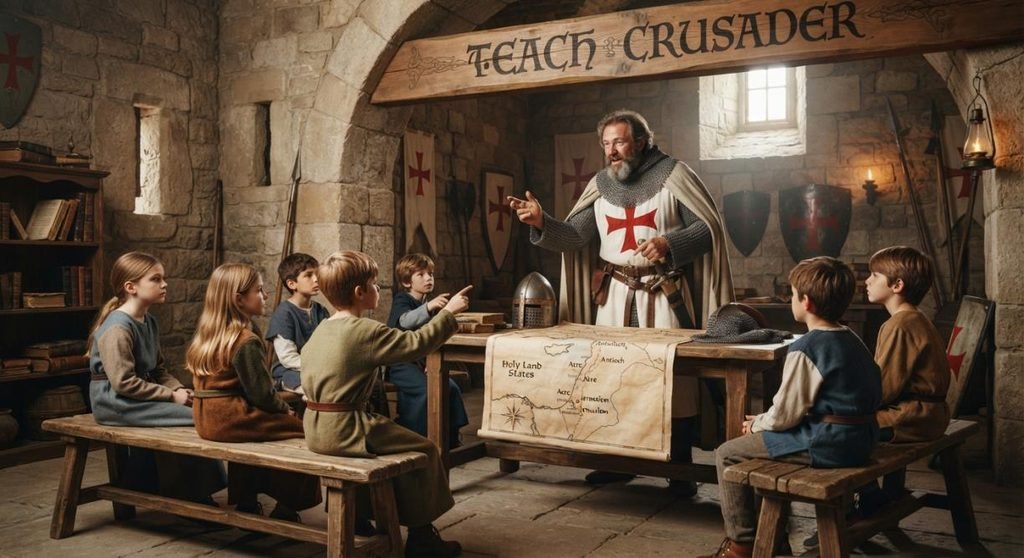
Military history can make the subject engaging, but it should include logistics and organization rather than focusing only on famous knights.
How Crusader Armies Functioned
Crusading armies could contain nobles, knights, infantry, religious personnel, servants, specialists, and other followers. Their composition varied between expeditions. The popular image of an army made entirely of armored knights is therefore misleading.
Why Fortifications Mattered
Castles and fortified settlements played an important role in controlling territory, protecting populations, storing supplies, and monitoring strategic routes. Teaching students to examine a castle’s location can reveal why geography mattered as much as battlefield strength.
The Importance of Siege Warfare
Many medieval campaigns revolved around fortified cities. Sieges required:
- Food and water
- Weapons and equipment
- Engineering skills
- Transportation
- Reinforcements
- Time
- Disease management
- Reliable supply routes
Teach Crusader History Through Major Figures
Introducing major individuals can help beginners remember complicated events, but personalities should remain connected to wider political developments.
Pope Urban II: Urban II is central to understanding the beginning of the First Crusade because of his 1095 call at Clermont.
Godfrey of Bouillon: Godfrey was one of the prominent leaders of the First Crusade and became closely associated with the early history of the Kingdom of Jerusalem.
Richard the Lionheart: Richard I of England played a major role in the Third Crusade. His campaigns illustrate the combination of military action and diplomacy that characterized the conflict.
Saladin: Saladin is one of the most important figures for understanding the political changes surrounding the Third Crusade. His victory at Hattin in 1187 preceded the recovery of Jerusalem by his forces and helped trigger the Third Crusade.
Alexios I Komnenos: The Byzantine emperor Alexios I provides an important perspective because Byzantine interests and Western crusading goals were not always identical.This broader cast of characters helps prevent the subject from becoming a story about only European knights and Muslim rulers.
Teach Crusader History From Multiple Perspectives
This is one of the most important principles for an accurate article or lesson. The Institute of Historical Research notes that its Crusades collection contains Muslim, Eastern Christian, and Latin perspectives, although Latin sources make up much of the surviving material.
Latin Christian Sources
Examples include chronicles produced by participants and observers of the First Crusade. Dartmouth’s Sources for Crusade History identifies works including the Gesta Francorum, Fulcher of Chartres, and other early accounts.
Muslim Sources
Arabic historical writing provides another perspective on the Crusades. These accounts can help students examine how Muslim historians understood the arrival, campaigns, and political development of the Crusaders.
Byzantine and Eastern Christian Sources
Byzantine and other Eastern Christian accounts are particularly valuable because they show that medieval Christianity was not politically or culturally uniform.
Why Multiple Perspectives Matter
Different authors had different audiences, experiences, purposes, and political environments. Their accounts can therefore disagree. That disagreement is not simply a problem. It is an opportunity to teach students how historians evaluate evidence.
Teach Crusader History Using Primary Sources
Primary sources allow students to move beyond modern summaries. Dartmouth’s academic resource collection brings together narrative sources, translated materials, charters, databases, and other research resources for studying the Crusades.
What Counts as a Primary Source?
For Crusader history, useful evidence can include:
- Chronicles
- Letters
- Official documents
- Charters
- Travel accounts
- Religious writings
- Archaeological evidence
- Contemporary material remains
Important First Crusade Sources
The Gesta Francorum is one important early account. Fulcher of Chartres and other writers also provide valuable evidence.
Dartmouth’s collection identifies several eyewitness and early accounts and provides bibliographical information about their editions and translations.
How to Evaluate a Medieval Source
Ask five basic questions:
- Who created the source?
- When was it produced?
- Who was its intended audience?
- Was the writer an eyewitness?
- What purpose might have influenced the account?
Teach Crusader History With a Beginner-Friendly Method
A simple learning sequence can make a complicated topic manageable.
Start With the Timeline: Teach 1095, 1099, 1187, 1189–1192, 1204, and 1291 as major reference points.
Add Geography: Maps should show Europe, Constantinople, Anatolia, the Levant, Jerusalem, Egypt, and major routes. Geography helps explain why travel was difficult and why particular cities mattered. Connect Causes and Consequences
Use this structure: Cause → Event → Immediate result → Long-term consequence For example, students can examine the political circumstances surrounding the loss of Jerusalem in 1187, the Third Crusade that followed, and the diplomatic outcome that allowed Christian pilgrims access to Jerusalem without restoring complete Latin political control over the city.
Use Source Comparisons: Give students two accounts of the same event and ask:
- What does each author emphasize?
- What information appears in both?
- Where do they disagree?
- What might explain the differences?
Practical Skills for Studying Crusader History
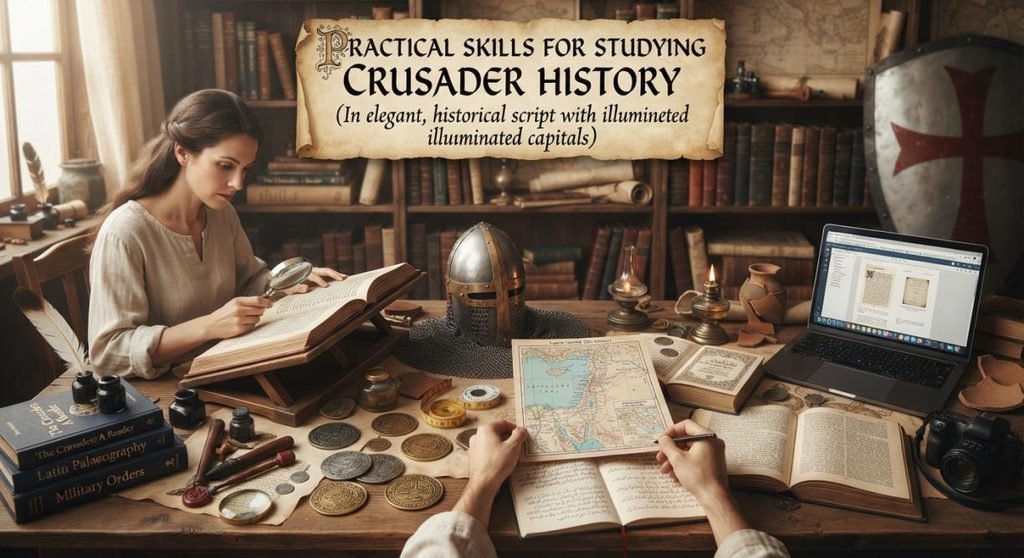
A strong student should develop several practical historical skills.
Chronology: Students should be able to place major campaigns and events in sequence.
Source Criticism: They should evaluate authorship, date, purpose, audience, and reliability.
Geographic Reasoning: Maps help students understand distances, strategic locations, and the difficulties of medieval travel.
Comparative Reading: Comparing Latin, Arabic, Byzantine, Armenian, and other evidence can reveal how historical narratives are constructed.
Evidence-Based Writing:
Students should distinguish between:
- What a source directly says
- What historians infer
- What remains disputed
- What is supported by multiple sources
A Simple Teach Crusader Lesson Plan
A six-part beginner sequence works well.
Define the Crusades: Introduce terminology, dates, geography, and the historical background of 1095.
Study the First Crusade: Cover Urban II, the expedition, major stages of the campaign, and the capture of Jerusalem.
Examine the Crusader States: Study Jerusalem, Edessa, Antioch, and Tripoli and explain how they interacted with surrounding powers.
Study Saladin and the Third Crusade: Introduce Hattin, the loss of Jerusalem, Richard I, military campaigns, and diplomacy.
Compare Historical Perspectives: Use translated primary sources and have students compare accounts.
Review Through Evidence: Finish with a timeline, map exercise, and short source-analysis assignment.
Reliable Sources for Crusader Research
High-quality research should rely on institutions and scholarly collections wherever possible. The Library of Congress provides a research guide covering books, databases, reference works, and other resources for Crusades research between 1095 and 1291. Dartmouth College’s Sources for Crusade History provides extensive bibliographical information on narrative sources and translations, including material from different phases of the Crusades.
The Institute of Historical Research at the University of London maintains Crusades collections containing historical sources, bibliographies, and reference works, including material representing Latin, Muslim, and Eastern Christian perspectives.
For orientation and locating references, but important claims should be checked against the scholarly sources cited in its articles. Its Crusades material identifies a broad range of primary sources, including Latin, Arabic, Greek, Armenian, and other traditions.
Conclusion
Teaching Crusader history can be challenging when students encounter complex timelines, unfamiliar places, competing perspectives, and conflicting historical accounts. Simply memorizing battles, rulers, and dates rarely creates meaningful understanding. A practical solution by combining chronology, geography, major events, military strategy, political developments, primary sources, and multiple perspectives into a clear learning framework.
Teach Crusader is not merely to help students remember the Crusades, but to help them understand why events happened, how different societies experienced them, and how historians evaluate evidence. With the right approach, Crusader history becomes clearer, more engaging, and far more meaningful.
FAQs about Teach Crusader
Q1. What is the easiest way to teach Crusader history to beginners?
Ans: Start with a simple timeline and map. Introduce 1095 and the First Crusade first, then add the Crusader states, later campaigns, major personalities, and primary sources. This gives beginners a framework before they encounter complicated debates.
Q2. What should you teach first about the Crusades?
Ans: Begin with terminology, geography, and historical context. Explain what a crusade meant in its medieval setting and why 1095 is important. Then move into the First Crusade.
Q3. How many Crusades were there?
Ans: There is no single universally useful number for every type of crusading activity. Historians commonly refer to numbered expeditions such as the First through Ninth Crusades, but crusading was a broader movement that also included campaigns outside the eastern Mediterranean. This is why teaching the numbered Crusades alone can give an incomplete picture.
Q4. Who were the main Crusader leaders?
Ans: Important figures include Godfrey of Bouillon and other leaders of the First Crusade, Richard I during the Third Crusade, and numerous European and regional rulers involved in later campaigns. Pope Urban II and Byzantine Emperor Alexios I Komnenos are also important for understanding the origins of the First Crusade.
Q5. Who was Saladin in Crusader history?
Ans: Saladin was the Muslim ruler whose victory at Hattin in 1187 helped lead to the recovery of Jerusalem. His campaigns became a major cause of the Third Crusade, during which Richard I and other European leaders fought against his forces.
Q6. What sources can be used to teach Crusader history?
Ans: Useful sources include chronicles, letters, charters, travel accounts, archaeological evidence, and translated medieval documents. Dartmouth’s Crusade source collection provides extensive bibliographical information for these materials.