

How to Use Home Equity to Build Wealth: Smart Strategies
Your home may be one of your largest assets, but having substantial equity does not automatically make you wealthier. The real opportunity—and the real risk—comes when you decide what to do with that equity. For many homeowners, the challenge is finding a way to turn existing home equity into productive capital without taking on more debt than they can comfortably manage. Used carefully, equity may help fund an investment property, improve an existing home, reduce expensive debt, or support a broader financial strategy.
How to use home equity to build wealth through practical strategies, realistic examples, financing comparisons, risk-management principles, and a step-by-step decision process. The goal is not to borrow the maximum amount available. It is to use your existing asset intelligently while protecting your long-term financial security.
Read More: Best Mattress for Sciatica: How to Choose the Right Support
What Is Home Equity?
Home equity is the portion of your home that you effectively own. It is calculated by subtracting the outstanding mortgage and other property-secured debt from the home’s current market value. Home equity = Current home value − Outstanding mortgage balance For example, if your home is worth $450,000 and you still owe $280,000 on your mortgage, your estimated equity is $170,000. However, $170,000 of equity does not mean you can automatically borrow $170,000. Lenders may consider your property value, existing mortgage, income, credit history, debt-to-income ratio, loan-to-value limits, and other qualification requirements.
How Does Home Equity Increase?
Home equity generally grows in two primary ways. First, your mortgage balance decreases as you make principal payments. Every dollar of principal you repay can increase the portion of the property you own. Second, your property may appreciate. For example, if a home purchased for $300,000 eventually becomes worth $400,000, the increase in market value can substantially increase equity. But appreciation is never guaranteed. Property values can decline, sometimes for years. That is why a responsible wealth-building strategy should not depend entirely on continued house-price growth.
Why Home Equity Is Different From Cash
Home equity is an asset, but it is not the same as having money sitting in a bank account. To access equity, you generally need to sell the property or borrow against it through a financial product such as a HELOC, home equity loan, or cash-out refinance. This distinction is critical when considering how to use home equity to build wealth. Borrowing against your home does not create wealth by itself. The potential benefit comes from what you do with the borrowed money and whether the resulting investment or financial improvement is worth the cost and risk.
How to Use Home Equity to Build Wealth
There is no single strategy that works for every homeowner. The right approach depends on income stability, existing debt, emergency savings, risk tolerance, investment experience, and the intended use of the money. A homeowner with strong cash reserves and manageable debt may have more flexibility than someone already living close to their monthly budget. Here are several strategies worth evaluating.
1. Use Home Equity to Buy an Investment Property
One of the most common approaches is using equity from an existing home to help finance another property. Depending on lender requirements, a homeowner may potentially use a HELOC or home equity loan toward a down payment or other acquisition costs for a rental property.
The potential sources of wealth include:
- Rental income
- Property appreciation
- Mortgage principal reduction
- Long-term portfolio growth
- Potential tax advantages, depending on local rules
For example:
| Monthly Item | Estimated Amount |
| Rental income | $2,500 |
| Mortgage | $1,450 |
| Taxes and insurance | $350 |
| Maintenance reserve | $200 |
| Vacancy allowance | $150 |
| Management/miscellaneous | $150 |
| Estimated cash flow | $200 |
2. Use Equity for Value-Adding Home Improvements
Another option is investing borrowed equity into your existing property.
Potential projects include:
- Kitchen improvements
- Bathroom renovations
- Energy-efficiency upgrades
- Roof replacement
- Structural repairs
- Additional living space
- Functional outdoor improvements
Before borrowing, consider:
- What buyers in your market actually want
- Whether the improvement solves a genuine problem
- Whether it reduces ongoing expenses
- Whether comparable homes support the expected value increase
- Whether the project could exceed its original budget
3. Use a HELOC for Carefully Planned Capital
A home equity line of credit, or HELOC, is a revolving credit facility secured by your home. It generally allows you to borrow as needed up to an approved limit during a draw period. This flexibility can make a HELOC useful for projects where expenses occur over time. For example, a property investor may need $10,000 initially for repairs, another $8,000 several months later, and additional funds after completing another stage of renovation. However, flexibility can also encourage unnecessary borrowing. An available credit limit should not be viewed as money you need to spend.
Before choosing a HELOC, examine:
- Interest rate
- Whether the rate can change
- Draw period
- Repayment period
- Minimum payments
- Fees
- Potential payment increases
- Conversion or repayment options
When evaluating how to use home equity to build wealth, the ability to borrow is less important than your ability to repay the debt comfortably.
4. Consider a Home Equity Loan
A home equity loan generally provides a lump sum secured by the property. This may be appropriate when you know exactly how much money you need and prefer a defined repayment schedule. For example, if a homeowner has a clearly planned $35,000 renovation, a home equity loan may provide a structured way to finance the project. Depending on the terms, a fixed-rate home equity loan can also make payments more predictable than a variable-rate HELOC. But never compare financing options only by monthly payment.
Consider:
- Interest rate
- Loan term
- Origination fees
- Closing costs
- Total interest
- Prepayment terms
- Total repayment amount
5. Use Equity to Consolidate High-Interest Debt
Debt consolidation can sometimes be another use of home equity. For example, replacing high-interest credit card balances with lower-cost home-secured borrowing may reduce interest expenses and improve monthly cash flow.
The savings could potentially be redirected toward:
- Emergency savings
- Retirement investing
- Mortgage principal
- Other productive assets
But debt consolidation does not make debt disappear.
Comparing Home Equity Strategies
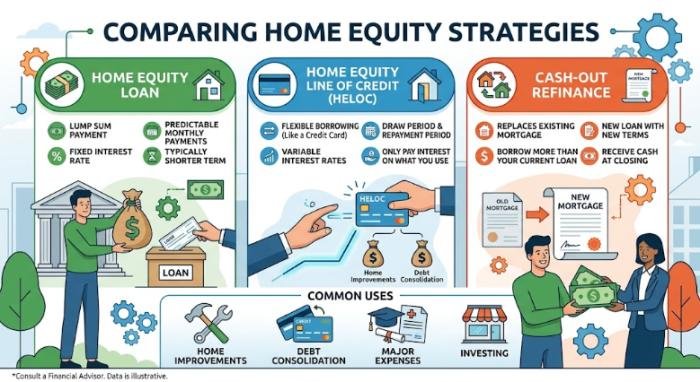
When evaluating how to use home equity to build wealth, compare each option based on its purpose, expected benefit, financing cost, and downside risk.
| Strategy | Potential Benefit | Main Risk | Question to Ask |
| Rental property | Income and appreciation | Vacancy and leverage | Does it produce realistic cash flow? |
| Home improvement | Functionality and potential value | Cost may exceed value created | Will the project add meaningful value? |
| HELOC | Flexible capital | Variable rates | Can I handle higher payments? |
| Home equity loan | Structured financing | Fixed repayment obligation | Is the project worth the total cost? |
| Debt consolidation | Potential interest savings | Home becomes collateral | Will I avoid new high-interest debt? |
| Cash-out refinance | Access to larger capital | Replaces existing mortgage | Does the new loan improve my finances? |
HELOC vs. Home Equity Loan vs. Cash-Out Refinance
Understanding your financing choices is essential before deciding how to use home equity to build wealth.
HELOC: A HELOC provides a revolving line of credit. You can generally borrow and repay funds during the draw period.
Advantages:
- Flexible access to capital
- Borrow only what you need
- Useful for ongoing projects
Disadvantages:
- Variable rates are common
- Payments may increase
- Easy access can encourage overspending
- Repayment can become more demanding later
Home Equity Loan: A home equity loan generally provides a lump sum with a defined repayment schedule.
Advantages:
- Predictable borrowing amount
- Structured payments
- Fixed-rate options may be available
Disadvantages:
- Interest costs
- Potential fees
- Less flexibility
- Your home secures the debt
Cash-Out Refinance
A cash-out refinance replaces your existing mortgage with a larger mortgage and provides the difference in cash, subject to qualification and lender terms. It can be useful in certain circumstances, but homeowners should carefully compare the new mortgage rate and total costs with their existing loan. Replacing a favorable mortgage with a significantly higher-rate loan could increase borrowing costs enough to undermine the benefit of accessing the equity.
How Much Home Equity Should You Borrow?
One of the most important principles in how to use home equity to build wealth is that your maximum borrowing capacity should never automatically become your borrowing target. Suppose your home is worth $500,000 and you owe $250,000. Your gross equity is approximately $250,000. That does not mean borrowing another $200,000 is financially sensible.
Keeping some equity untouched can provide a buffer against:
- Falling property values
- Unexpected repairs
- Income loss
- Investment losses
- Higher interest rates
- Temporary cash-flow problems
The Five-Number Test Before Borrowing
Before using home equity for an investment, calculate five numbers.
1. Total Borrowing Cost
Do not focus only on the advertised interest rate. Include:
- Interest
- Origination fees
- Appraisal costs
- Closing costs
- Annual fees
- Potential rate increases
2. Expected Investment Return
Estimate returns conservatively. For rental property, calculate net cash flow after realistic expenses rather than relying on gross rent. For renovations, estimate the likely value created instead of assuming every dollar spent will be recovered. For a business investment, consider realistic revenue, operating costs, and the possibility that growth may take longer than expected.
3. Cash-Flow Cushion
Calculate how much money remains every month after debt payments and essential expenses. If the plan leaves only $100 or $200 of spare cash, one unexpected expense could create significant pressure.
4. Downside Scenario Test what happens if:
- Rent falls
- A property stays vacant
- Repairs become expensive
- Interest rates increase
- Your investment loses value
- A renovation exceeds budget
- Your income temporarily declines
5. Exit Strategy
Know how the debt will eventually be repaid. Potential repayment sources could include:
- Investment cash flow
- Employment income
- Business income
- Property sale
- Investment sale
- Refinancing
- Planned asset liquidation
A Practical Example of Responsible Leverage

Consider a hypothetical homeowner with:
- Home value: $600,000
- Mortgage balance: $320,000
- Estimated equity: $280,000
- Stable household income
- Six months of emergency savings
- Low consumer debt
Instead of asking, “How much can I borrow?” they ask:
- What will the new monthly payment be?
- What will the rental generate after all expenses?
- What happens during a six-month vacancy?
- Can household income cover both properties?
- What happens if the property loses 15% of its value?
- What are the loan fees?
- How will the debt ultimately be repaid?
This is why how to use home equity to build wealth should always involve a margin-of-safety mindset rather than relying on optimistic projections.
The Biggest Risks of Using Home Equity
A responsible strategy must consider the downside as carefully as the potential upside.
Your Home Secures the Debt
Home equity loans and HELOCs are generally secured by your property. If you cannot meet your repayment obligations, you could face serious financial consequences, potentially including foreclosure. That makes home equity borrowing fundamentally different from investing money you can afford to lose.
Investment Returns Are Not Guaranteed
Real estate prices can decline. Stocks can lose value. Businesses can fail. Rental properties can remain vacant. Renovations can exceed budget.
Interest Rates Can Rise
Variable-rate borrowing creates additional uncertainty. If borrowing costs increase, an investment that initially looked profitable may become much less attractive. For that reason, stress-test your plan using a higher interest rate before committing.
Leverage Magnifies Losses
Imagine purchasing a $300,000 investment property. If it increases 10%, its value rises by $30,000. If it falls 10%, its value falls by $30,000. The debt does not automatically decrease just because the property’s market value declines. Leverage can accelerate wealth creation, but it can also accelerate losses.
Advanced Strategy: Building a Real Estate Portfolio
Experienced investors may use equity from existing properties to help acquire additional properties.
This can accelerate portfolio growth, but every additional property also adds:
- Debt
- Maintenance
- Vacancy exposure
- Management responsibilities
- Interest costs
- Market risk
- Liquidity requirements
Track:
- Total property value
- Total debt
- Net cash flow
- Debt-service coverage
- Interest expense
- Vacancy
- Maintenance reserves
- Available cash
- Geographic concentration
Balance Home Equity With Other Investments
Another important part of how to use home equity to build wealth is understanding diversification. If most of your net worth is already tied to your home, borrowing against it to purchase additional real estate may increase concentration rather than diversification.
Depending on your goals, a broader financial plan could include:
- Home equity
- Retirement accounts
- Diversified investments
- Cash reserves
- Business interests
- Income-producing property
What About Home Equity Investment Contracts?
Homeowners may encounter products marketed as home equity investments or home equity agreements. These arrangements can differ significantly from traditional HELOCs and home equity loans. Some provide upfront funds in exchange for a future payment that may be linked partly to the home’s value. The repayment structure can be complicated.
Before considering such a product, understand:
- How future repayment is calculated
- What happens if the home appreciates
- What happens if the home loses value
- When repayment becomes due
- What happens if you sell
- Whether refinancing is affected
- How improvements affect valuation
- All fees and contractual restrictions
Tax Considerations
Tax treatment varies by country, state, and the way borrowed funds are used. Do not assume that interest on a HELOC or home equity loan is automatically deductible. Rental income, capital gains, depreciation, property taxes, investment expenses, and other items can also receive different tax treatment depending on your circumstances. Before making a large financial decision, consult a qualified tax professional familiar with the rules that apply to you.
A Step-by-Step Decision Framework
If you are still evaluating how to use home equity to build wealth, follow a structured process rather than making a decision based on available borrowing capacity.
Step 1: Calculate Your Net Equity
Estimate your home’s current value and subtract your mortgage and other relevant liens.
Step 2: Review Existing Debt
Look at your mortgage, credit cards, personal loans, monthly obligations, and overall debt-to-income position.
Step 3: Define the Purpose
Be specific. “Investing” is too vague. “Using $50,000 toward a rental property projected to generate positive cash flow after realistic expenses” is measurable.
Step 4: Compare Financing Options
Compare multiple financing offers when practical.
Review:
- Interest rate
- Fixed vs. variable rate
- Fees
- Loan term
- Monthly payment
- Total interest
- Prepayment terms
- Potential rate changes
Step 5: Calculate a Conservative Return
Use realistic assumptions rather than the best possible outcome.
Step 6: Stress-Test the Plan
Ask what happens if income falls, expenses increase, interest rates rise, or the investment declines in value.
Step 7: Protect Your Emergency Fund
Do not invest every available dollar simply because you have access to equity.
Step 8: Establish an Exit Strategy
Know how and when the borrowed money will be repaid.
Step 9: Review the Strategy Annually
Financial circumstances change.
Review:
- Interest rates
- Debt balances
- Property values
- Investment performance
- Cash flow
- Emergency savings
- Long-term goals
People Also Ask
Is using home equity a good way to build wealth?
It can be, provided the borrowed money has a productive purpose and the expected benefit reasonably exceeds the financing cost and risk. Borrowing against equity increases both potential returns and potential losses.
What is the smartest way to use home equity?
There is no single answer. A strong use generally has a clearly defined purpose, manageable repayment costs, realistic expected benefits, and enough financial protection to handle setbacks.
Can I use home equity to buy a rental property?
In some circumstances, homeowners may use a HELOC or home equity loan to help finance an investment property. Qualification requirements and lending rules vary.
Is a HELOC better than a home equity loan?
Neither is automatically better. A HELOC typically offers greater flexibility but may have a variable rate, while a home equity loan generally provides a lump sum with a defined repayment structure.
Can using home equity to invest make you lose your home?
Yes. Because home equity borrowing is secured by the property, failure to repay the debt can create serious consequences, potentially including foreclosure.
Final Takeaway
Home equity can be a powerful financial resource, but it can also become a serious liability when borrowed without a clear purpose. The biggest mistake is focusing on how much equity you can access instead of asking what that borrowed money can realistically accomplish. How to use home equity to build wealth is built around three things: a productive purpose, conservative numbers, and protection against the unexpected.Whether you are considering a rental property, renovation, debt consolidation, or another investment,
The strategy should still work when markets fall, expenses rise, income changes, or plans take longer than expected. Your home should support your financial future—not put it unnecessarily at risk. Borrow strategically, preserve liquidity, stress-test every assumption, and make sure the potential reward is worth the cost of the debt. The goal is not to maximize leverage.
FAQS about how to use home equity to build wealth
Q1: What is home equity?
Ans: Home equity is the current market value of your home minus the outstanding balance of mortgages and other liens secured by the property.
Q2: How to use home equity to build wealth?
Ans: Potential approaches include carefully evaluated rental-property investments, value-adding home improvements, and strategic debt restructuring. Every strategy should be evaluated based on financing costs, cash flow, risk, and repayment ability.
Q3: How much home equity can I borrow?
Ans: The amount depends on your property’s value, mortgage balance, lender limits, income, credit profile, debt-to-income ratio, and other underwriting factors. Having substantial equity does not mean you can borrow all of it.
Q4: Is a HELOC risky?
Ans: Yes. A HELOC is secured by your home and commonly carries a variable interest rate. Payments can increase, and failure to repay can put your property at risk.
Q5: Should I use home equity to pay off credit cards?
Ans: It may reduce interest costs in some situations, but it also changes the nature of the debt by putting your home behind the borrowing. A strong strategy should include a plan to prevent new high-interest debt from accumulating.
Q6: Can home improvements increase wealth?
Ans: Some improvements can increase functionality, energy efficiency, marketability, or property value. However, the financial return varies by project and local market, so the cost and expected benefit should be carefully compared.
Q7: What is the difference between a HELOC and a home equity loan?
Ans: A HELOC is generally a revolving credit line that allows repeated borrowing during a draw period. A home equity loan typically provides a lump sum that is repaid according to a defined schedule.
Q8: Should I use all my available equity?
Ans: No. Maximum borrowing capacity should not automatically be your target. Keeping unused equity and liquid savings can provide protection against emergencies, falling property values, investment losses, and income disruptions.
Q9: Is home equity part of net worth?
Ans: Yes. Home equity generally contributes to net worth because it represents the portion of the property’s value remaining after secured debt is deducted. However, it is less liquid than cash and many financial investments.
Q10: Can home equity help with retirement planning?
Ans: It can be one component of a retirement strategy. Depending on your circumstances, possibilities may include downsizing, selling the property, or using carefully structured financing. The right approach depends on income needs, taxes, housing plans, debt, and long-term goals.