

Blackhatworld: Digital Marketing Strategies for SEO and Online Business
Blackhatworld is a popular keyword associated with digital marketing, search engine optimization (SEO), affiliate marketing, and online business strategies. In today’s competitive online environment, website owners and digital marketers are constantly searching for effective ways to improve search rankings, attract targeted traffic, and increase online revenue.
Understanding different marketing techniques can help beginners and experienced professionals make better decisions for their websites. By focusing on keyword research, quality content, website optimization, and audience engagement, businesses can build a stronger online presence and create opportunities for sustainable growth.
What Is blackhatworld?
blackhatworld is known as an online community focused on internet marketing and digital entrepreneurship. Its subject areas can appeal to beginners who are building their first websites as well as experienced marketers who manage multiple projects. Topics commonly associated with this community include keyword research, link building, affiliate marketing, search engine optimization, website development, advertising, and online revenue generation.
Read More: Thehometrotters Homerepairs: Smart Tips for Home Repair and Maintenance
One reason marketing forums attract attention is that digital marketing involves many different disciplines. A website owner may need to understand technical SEO, content planning, conversion optimization, analytics, and customer acquisition at the same time. Participating in marketing discussions can help people compare ideas and identify areas where their existing strategies need improvement.
However, forum discussions should be treated as sources of opinions and experiences rather than guaranteed solutions. A method that works for one website may not work for another because competition, website history, audience behavior, and business objectives differ. Before adopting a recommendation, marketers should examine its potential benefits, risks, and compatibility with their goals.
Why blackhatworld Matters for SEO and Online Business
Search engine optimization remains an important way to attract visitors who are actively searching for information, products, or services. Unlike some forms of paid advertising, organic search can continue to generate traffic after a page has been published and optimized. Nevertheless, strong rankings require consistent effort, useful content, technical quality, and a clear understanding of search intent.
Marketing communities such as blackhatworld are relevant to people who want to discuss SEO challenges and compare different strategies. A website owner might seek ideas for improving internal links, researching long-tail keywords, organizing website categories, or identifying opportunities to attract qualified visitors.
The value of these discussions depends on how carefully the information is evaluated. Search engine algorithms change, competition develops, and tactics that previously produced results may become ineffective or risky. Businesses should therefore prioritize methods that improve the website for real visitors while supporting their broader marketing objectives.
For online businesses, the ultimate goal is not simply to attract more visitors. It is to attract the right visitors and help them take meaningful actions, such as subscribing to a newsletter, requesting a quote, purchasing a product, or returning for additional information.
Main Digital Marketing Strategies Associated With blackhatworld
Digital marketing includes several interconnected activities. Understanding these areas can help website owners decide which methods deserve their time and resources.
The following table summarizes important digital marketing strategies, their primary purposes, and practical considerations for implementation.
| Digital Marketing Strategy | Main Purpose | Practical Approach | Important Consideration |
| Search Engine Optimization | Improve organic visibility | Optimize content, page structure, and technical performance | Follow search engine guidelines |
| Keyword Research | Identify relevant search opportunities | Analyze search intent, competition, and topic relevance | Avoid targeting irrelevant terms |
| Content Marketing | Attract and inform an audience | Publish useful articles, guides, and resources | Prioritize originality and accuracy |
| Link Building | Strengthen discovery and authority signals | Earn relevant editorial links and industry mentions | Avoid manipulative link schemes |
| Affiliate Marketing | Generate commission-based revenue | Promote relevant products through useful content | Disclose affiliate relationships |
| Email Marketing | Build lasting audience relationships | Send valuable newsletters and targeted campaigns | Obtain consent and respect privacy |
| Paid Advertising | Reach targeted potential customers | Test campaigns with clear conversion goals | Monitor costs and return on investment |
| Conversion Optimization | Improve the percentage of visitors who act | Simplify forms, improve calls to action, and test page layouts | Use reliable performance data |
Search Engine Optimization for Long-Term Growth
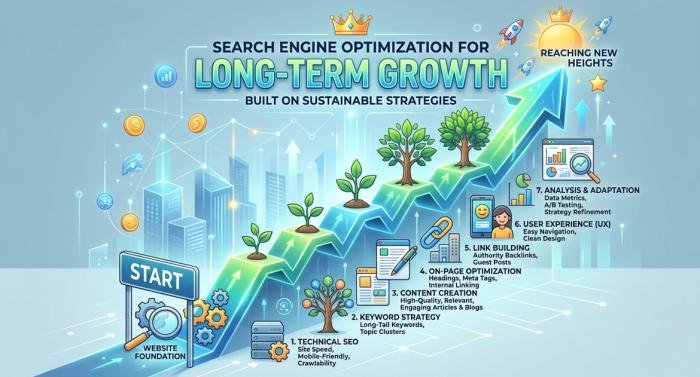
SEO helps search engines interpret website content and helps users find relevant information. A well-optimized website has a clear structure, accessible pages, descriptive titles, helpful content, and links that make navigation straightforward.
A strong SEO strategy begins with understanding the needs of the intended audience. Website owners should identify the questions people ask, the problems they want to solve, and the information they expect to find. Content that addresses these needs directly is more useful than pages created solely to repeat popular keywords.
Technical SEO also plays an important role. Websites should load efficiently, work on mobile devices, use secure connections, and avoid unnecessary navigation barriers. Broken links, duplicate pages, confusing URL structures, and indexing problems can make it harder for search engines and visitors to access important content.
Another important factor is internal linking. Links between related pages help visitors navigate a website and provide context about how different topics connect. For instance, an article about keyword research might link to a related guide about content planning or website analytics.
Keyword Research and Search Intent
Keyword research helps marketers understand the words and phrases people use when searching online. It also helps determine which topics deserve dedicated pages and which subjects can be covered together in a comprehensive article.
The first step is to identify the main topic of a website. A business that provides SEO services, for example, might research phrases related to technical SEO, local search optimization, content marketing, and website audits. Each keyword should be evaluated according to relevance, search intent, competition, and its potential contribution to business objectives.
Search intent describes what a person wants to accomplish with a search. Some searches are informational, meaning the user wants an answer or explanation. Others are navigational, commercial, or transactional. Understanding this distinction helps marketers create pages that match visitor expectations.
Long-tail keywords can also be valuable. These are more specific search phrases that often communicate a clearer need. Although individual long-tail terms may receive fewer searches, they can attract visitors who are looking for a particular solution.
Content Marketing That Builds Trust
Content marketing involves creating and distributing material that informs, helps, or engages a target audience. Examples include blog posts, tutorials, case studies, comparison articles, videos, downloadable resources, and email newsletters.
Effective content starts with a clearly defined audience. A beginner looking for an introduction to SEO needs different information from an experienced marketer troubleshooting a technical indexing issue. When businesses understand their audience’s experience level and objectives, they can provide more relevant guidance.
Originality is another important consideration. Publishing another version of information that already appears on numerous websites rarely gives readers a compelling reason to return. Businesses can improve their content by incorporating practical examples, first-hand experience, verified facts, clear explanations, and actionable recommendations.
Content organization matters as well. Descriptive headings, concise paragraphs, lists, and relevant examples make articles easier to navigate. Readers should be able to identify the main points quickly and locate the information that answers their questions.
A content calendar can help maintain consistency. Instead of publishing unrelated articles whenever time permits, businesses can plan topics around audience needs, seasonal opportunities, and important product or service categories. This creates a more coherent website and helps establish topical relevance.
White-Hat SEO and Risky Optimization Tactics
Discussions about blackhatworld may include different approaches to improving search rankings. Some methods focus on producing useful content and earning legitimate recommendations, while others attempt to manipulate search engine systems.
White-hat SEO emphasizes practices that align with search engine guidelines. These include creating helpful content, improving technical accessibility, organizing website information clearly, and earning relevant links through genuine value. Such methods may require patience, but they support a stronger foundation for long-term growth.
Black-hat SEO commonly refers to tactics intended to manipulate rankings in ways that violate search engine spam policies. Examples can include buying links to manipulate ranking signals, cloaking content, using doorway pages, and creating large quantities of low-value pages primarily to influence search results.
These techniques can create serious risks. Search engines may ignore manipulative links, reduce the visibility of affected pages, or apply manual actions when policy violations occur. Recovering from ranking losses can require substantial time and resources.
Not every unconventional marketing experiment is automatically a violation. The relevant question is whether a tactic provides genuine value and complies with the applicable platform’s rules. Website owners should evaluate proposed methods carefully, document their results, and avoid strategies that depend on deception or artificial manipulation.
Link Building and Website Authority

Backlinks are links from other websites that point to a particular page. They can help people discover useful resources and may contribute to search engine assessments of a page’s relevance and authority. However, link quality, context, and authenticity matter more than simply accumulating a large number of links.
A sustainable link-building strategy begins with creating resources worth referencing. Original research, useful tutorials, practical tools, industry reports, and well-organized guides can give other publishers a legitimate reason to link to a website.
Digital PR is another approach. Businesses can share relevant findings with journalists, industry publications, and professional communities. When the information is genuinely useful, it may attract coverage and natural references.
Guest contributions can also help when they are written for a relevant audience and published on reputable websites. The primary purpose should be to provide useful information and reach readers, not to manufacture ranking signals through excessive keyword-rich links.
Website owners should be cautious about link packages promising thousands of backlinks within a short period. Artificial link patterns can expose a website to search spam risks without producing meaningful visitors or customers.
Affiliate Marketing and Online Revenue
Affiliate marketing allows publishers to earn commissions by referring customers to products or services. It can be attractive to bloggers, content creators, niche website owners, and entrepreneurs who want to build revenue without developing their own products.
A successful affiliate website usually focuses on a specific audience or category. For example, a technology website might publish product comparisons, setup tutorials, buying guides, and troubleshooting resources. These pages help readers make informed decisions while providing relevant opportunities to include affiliate links.
Trust is essential. Recommendations should be honest, supported by appropriate research, and relevant to the reader’s needs. Publishers should disclose affiliate relationships clearly and follow the legal and platform requirements that apply to their location and audience.
Revenue depends on several factors, including traffic quality, purchase intent, commission structure, conversion rates, and product relevance. A large audience does not automatically produce strong earnings if visitors are not interested in the products being promoted.
Paid Advertising and Traffic Generation
Paid advertising can help businesses reach a specific audience more quickly than organic strategies alone. Search ads, social media campaigns, display advertising, and sponsored placements each offer different targeting options and performance characteristics.
The best campaign begins with a clearly defined objective. A business may want to generate leads, sell products, increase registrations, or promote a new service. The objective determines which metrics should be monitored and how the campaign should be structured.
Targeting is equally important. Businesses should consider audience interests, geographic areas, search behavior, demographics where appropriate, and the stage of the customer journey. More relevant targeting can reduce wasted spending and improve the quality of incoming traffic.
Landing pages must match the promises made in advertisements. If an advertisement promotes a specific service, visitors should arrive on a page that clearly explains that service and provides an appropriate next step. A mismatch between the advertisement and the landing page can lead to poor conversion rates.
Paid campaigns should be tested with controlled budgets. Marketers can compare different headlines, creative formats, audiences, and landing pages while monitoring cost per lead, cost per acquisition, and return on advertising spend.
Website Monetization Strategies
Website monetization involves converting an online audience into revenue. The most suitable approach depends on the website’s subject, traffic sources, audience expectations, and business model.
Display advertising is one option for content-based websites. Publishers earn revenue when eligible advertisements are displayed or interacted with according to the advertising network’s payment model. Results depend on audience location, content category, advertiser demand, and the quality of traffic.
Affiliate marketing provides another option by connecting useful recommendations with relevant products. Digital products, memberships, online courses, consulting services, and sponsored content may also create revenue opportunities.
Businesses should avoid adding so many advertisements that the website becomes difficult to use. Excessive pop-ups, intrusive placements, and misleading calls to action can damage trust and discourage repeat visits.
A balanced monetization strategy considers both immediate income and long-term audience relationships. Providing a good experience encourages visitors to return, recommend the website, and engage with future content.
Using Analytics to Measure Marketing Performance
Analytics helps marketers understand how visitors find a website, which pages they use, and whether they complete important actions. Without measurement, businesses may continue investing in activities that produce little value.
Organic search performance can be monitored through tools such as Google Search Console. It provides information about search queries, impressions, clicks, indexing, and other search-related signals. Website analytics tools can provide additional information about user behavior, traffic sources, and conversions.
Useful metrics depend on the business model. Publishers may monitor organic clicks, engaged visits, returning users, and newsletter registrations. Online stores may focus on product views, add-to-cart activity, purchases, average order value, and customer acquisition costs.
It is important to interpret metrics in context. An increase in impressions without a corresponding increase in clicks may suggest that titles or snippets need improvement, although changes in search position and query mix can also affect results. A drop in traffic may reflect seasonality, technical problems, competition, or broader search changes.
Marketers should establish a baseline before making major changes. Recording the date of a content update or technical adjustment makes it easier to compare results over time. Decisions based on consistent evidence are generally more reliable than reactions to short-term fluctuations.
How Beginners Can Build a Practical SEO Strategy
Beginners can make progress by concentrating on a manageable set of activities instead of attempting every digital marketing technique at once.
The first step is choosing a clear website topic and defining the intended audience. A focused subject makes it easier to research relevant keywords, organize content, and develop a recognizable brand.
Next, conduct keyword research and group related queries into topic clusters. Each important page should have a clear purpose and address the search intent behind its target terms. Avoid creating separate pages for nearly identical queries unless there is a meaningful difference in user needs.
The third step is publishing useful, well-structured content. Articles should provide accurate information, explain unfamiliar concepts, and answer likely follow-up questions. Relevant internal links can guide readers toward related resources.
After publishing, check that pages are accessible to search engines and function correctly on mobile devices. Review page titles, descriptions, headings, images, and navigation to ensure that they support a good user experience.
Finally, monitor performance and make improvements based on evidence. Some pages may need stronger explanations, better internal links, updated information, or more relevant calls to action. Consistency and careful evaluation are more useful than repeatedly changing strategies in response to isolated ranking movements.
The Role of Marketing Communities in Professional Development
Digital marketing changes continually, which makes professional discussion useful for people who want to improve their skills. Marketing communities can provide opportunities to compare experiences, ask technical questions, discuss tools, and understand how other professionals approach common problems.
A community associated with blackhatworld may expose members to a broad range of online business subjects. However, the quality of advice can vary considerably. Some participants may have extensive experience, while others may share incomplete information or conclusions based on a single experiment.
A thoughtful approach is to compare community recommendations with official documentation, reliable technical resources, and results from controlled tests. Marketers should distinguish between a personal anecdote and evidence that a method works consistently across different situations.
Professional development also requires practical experience. Reading discussions can help generate ideas, but testing those ideas on an appropriate project is necessary to determine whether they are effective. Keeping records of changes, outcomes, and lessons learned can improve future decisions.
The most valuable participation involves asking specific questions, sharing relevant context, respecting community rules, and contributing helpful information. This approach supports stronger professional relationships and makes discussions more productive.
Future Trends in SEO and Online Business
The digital marketing industry continues to evolve as search technology, artificial intelligence, advertising systems, and consumer behavior change. Businesses should remain flexible while maintaining a focus on quality and measurable value.
Artificial intelligence can assist with research, content organization, data analysis, and repetitive tasks. However, automated output still requires editorial judgment, factual verification, and meaningful human input. Publishing large quantities of unreviewed material is not a reliable substitute for meeting audience needs.
Search experiences are also becoming more varied. Users may discover information through traditional search results, AI-assisted interfaces, video platforms, social networks, and specialized communities. Businesses can benefit from understanding where their audiences spend time rather than relying exclusively on one channel.
Privacy and data protection are increasingly important as well. Marketers should collect information responsibly, explain how personal data is used, and comply with relevant privacy requirements. Trust can become a competitive advantage when customers know that a business handles their information carefully.
The most resilient businesses are likely to be those that combine technical competence with strong customer relationships. Useful content, reliable services, accessible websites, and honest communication can support growth even as individual platforms and tactics change.
Conclusion
Blackhatworld is a relevant keyword for discussions about digital marketing, SEO strategies, affiliate marketing, traffic generation, and online business development. These subjects offer many opportunities for people who want to create websites, promote services, and build sustainable digital revenue.
Successful marketing requires a combination of research, practical execution, performance measurement, and continuous improvement. Keyword research helps identify audience needs, content marketing provides useful answers, technical SEO supports accessibility, and analytics reveals which activities produce meaningful results.
Although aggressive optimization tactics may appear attractive because of their promise of quick results, businesses should evaluate their risks carefully. Strategies that rely on deception or search manipulation can undermine website visibility and long-term Credibility. A stronger foundation comes from creating genuine value, following applicable platform policies, and building relationships with an audience.
Whether someone is starting a new website or improving an established business, the best approach is to set clear goals, test ideas responsibly, and make decisions based on reliable evidence. Marketing communities can contribute useful perspectives, but each recommendation should be assessed according to the needs of the business and the quality of its supporting evidence.
FAQs
Q1: What is blackhatworld used for?
Ans: blackhatworld is associated with an online marketing community where people discuss search engine optimization, affiliate marketing, website traffic, content creation, digital advertising, and other online business topics. Users may participate to exchange experiences, ask questions, and discuss marketing strategies.
Q2: Is blackhatworld useful for SEO beginners?
Ans: It can be useful for beginners who want to discuss SEO concepts and marketing challenges. However, newcomers should verify recommendations using reliable documentation and practical testing. Not every tactic discussed by a community member will be appropriate for every website.
Q3: What is the difference between white-hat SEO and black-hat SEO?
Ans: White-hat SEO focuses on improving website quality and visibility through practices that align with search engine guidelines. Black-hat SEO generally refers to techniques intended to manipulate rankings in ways that violate those guidelines. Manipulative tactics can expose websites to ranking losses or search engine penalties.
Q4: Can blackhatworld help with affiliate marketing?
Ans: Marketing communities can provide discussion opportunities related to affiliate websites, product promotion, content planning, and traffic acquisition. Affiliate marketers should independently verify advice, disclose commercial relationships, and recommend products honestly to maintain audience trust.
Q5: How can I improve my website’s Google rankings?
Ans: Start by creating useful content that matches search intent, improving technical accessibility, organizing pages logically, building relevant internal links, and earning legitimate editorial backlinks. Monitor search performance and address technical issues. Rankings are influenced by many factors, so no strategy can guarantee a specific position.
Q6: Is buying backlinks a good SEO strategy?
Ans: Buying links intended to manipulate search rankings can violate search engine spam policies and create risks for a website. A more sustainable approach is to publish valuable resources, build genuine industry relationships, and earn relevant editorial mentions. Paid advertising and legitimate sponsorships should be handled transparently and according to applicable rules.