Droven.io Enterprise Tech Innovation: A Practical Business Guide
Businesses today face a difficult challenge: technology is advancing faster than many organizations can adapt. Outdated systems, repetitive workflows, disconnected data, and rising customer expectations can make growth slower and more expensive. This is where Droven.io enterprise tech innovation becomes a relevant topic for businesses seeking smarter digital strategies.
Modern solutions such as artificial intelligence, automation, cloud computing, analytics, and cybersecurity can help organizations improve efficiency and make better decisions. Droven.io enterprise tech innovation connects with modern enterprise technology, the major technologies shaping business transformation, practical applications, and the factors companies should consider before adopting new digital solutions.
Read more: BetterThisWorld Stocks Investor Guide, Analysis & Market Insights
What Is Droven.io Enterprise Tech Innovation?
Technology is no longer something businesses use only behind the scenes. It influences customer experiences, employee productivity, decision-making, communication, security, and long-term growth.
Droven.io enterprise tech innovation are becoming increasingly relevant to business owners, technology professionals, developers, and organizations evaluating new digital solutions. The phrase combines two related ideas.
Droven.io is associated with technology-focused information and discussions around areas such as artificial intelligence, emerging technology, software development, startups, and digital innovation. Enterprise tech innovation, on the other hand, describes the practical use of technology to improve business processes, solve organizational problems, and create measurable value.
The Role of Technology-Focused Information
Technology changes quickly. New AI applications, automation platforms, cloud services, cybersecurity approaches, and software development methods appear regularly. For business leaders, keeping track of these developments can be difficult.
This is where technology-focused content can provide value. A resource covering Droven.io enterprise tech innovation can help readers become familiar with technology categories before deciding whether a particular solution deserves further investigation.
For example: A business may hear about generative AI but not know how it could apply to daily operations. Research can help the team identify possible use cases, risks, limitations, and questions to ask vendors.
However, online technology content should be treated as an early research resource. Important purchasing, security, compliance, and implementation decisions should be supported by authoritative documentation and professional evaluation.
Enterprise Innovation Explained
Enterprise tech innovation is not simply about purchasing the latest technology. Real innovation happens when technology creates a meaningful improvement. A company might use automation to reduce repetitive administrative work. Another organization might use AI to process large volumes of documents.
A retailer could use analytics to improve demand forecasting, while a manufacturer might use connected sensors to monitor equipment. The technology itself is only one part of the equation. The more important question is whether the technology helps the organization achieve a measurable business objective.
Technologies Driving Modern Enterprise Innovation
Several technology categories are currently influencing how organizations build and improve their digital operations. Understanding these categories makes Droven.io enterprise tech innovation more relevant to businesses searching for practical technology opportunities.
Artificial Intelligence
Artificial intelligence has become one of the most discussed areas of enterprise technology. Businesses can use AI for customer support, document processing, forecasting, recommendation systems, data analysis, fraud detection, knowledge management, and many other activities.
Generative AI has also created new possibilities for working with text, images, code, and other forms of content. But organizations should avoid adopting AI simply because it is popular. A successful AI project should begin with a specific business problem. Companies also need to consider data quality, privacy, security, accuracy, human oversight, and operational costs.
Automation
Automation helps organizations reduce repetitive manual work. Common examples include automated notifications, invoice processing, employee onboarding, approval workflows, data transfers, reporting, and customer communications. When automation is combined with AI, businesses can create more flexible workflows.
An AI system might classify incoming information and then send it automatically to the correct business process. The goal is not necessarily to replace employees. Instead, automation can allow employees to spend more time on complex tasks that require judgment, creativity, communication, and expertise.
Cloud Computing
Cloud technology has transformed enterprise infrastructure. Organizations can use cloud services for computing, storage, databases, applications, backups, analytics, and development environments. Cloud infrastructure can provide flexibility and scalability, but it also requires responsible management.
Companies need to consider access permissions, identity management, security, data protection, compliance, architecture, and cloud costs. A successful cloud strategy therefore involves more than moving existing applications from local servers to cloud infrastructure.
Data Analytics
Data has become one of the most valuable resources for modern businesses. Organizations collect information from sales platforms, websites, customer systems, financial applications, operational software, and connected devices. Analytics can turn that information into useful business intelligence.
A retailer might analyze purchasing patterns. A logistics company could study delivery performance. A manufacturer might monitor production data. A service provider could examine customer response times. The purpose is to transform raw data into better decisions.
Cybersecurity
Technology innovation also creates new security responsibilities. As companies connect more cloud services, applications, employees, devices, and third-party platforms, their digital environments can become increasingly complex. Cybersecurity should therefore be considered part of innovation rather than an afterthought.
Important areas include identity protection, access management, encryption, vulnerability management, threat monitoring, incident response, and employee awareness.When evaluating a technology provider, organizations should also consider how the provider handles sensitive information and protects connected systems.
Why Enterprise Technology Innovation Matters
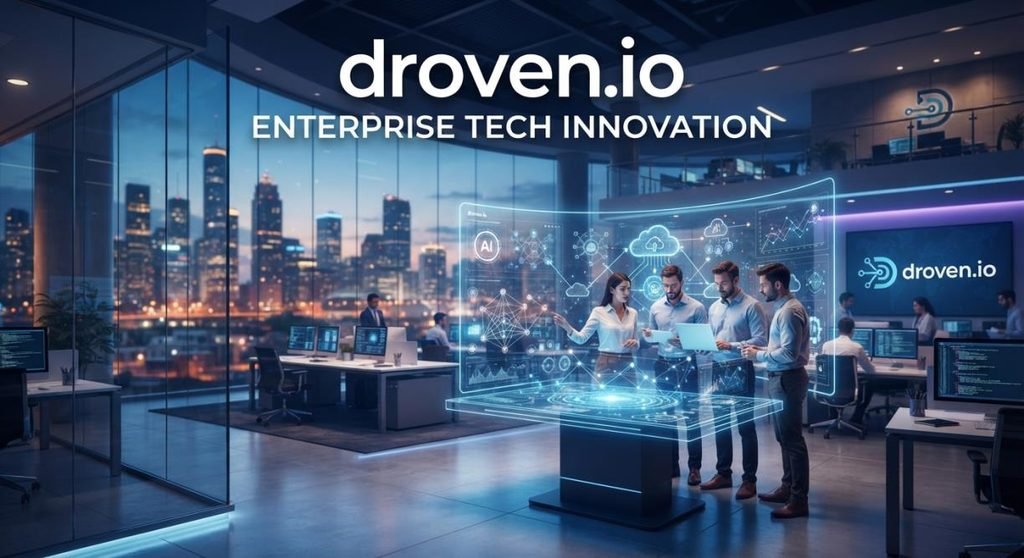
The business environment changes continuously. Customer expectations evolve, competitors introduce new digital services, employees expect efficient tools, and organizations face increasing volumes of data. This makes technology strategy important for both large companies and smaller businesses. The value of Droven.io enterprise tech innovation becomes clearer when technology is connected to practical business challenges.
For example, a company with slow administrative processes may benefit from automation. A business struggling with fragmented information could investigate better data integration. An organization facing high customer-support volumes might evaluate AI-assisted service tools. Successful technology projects typically have several characteristics:
- A clearly defined business problem
- Measurable objectives
- Appropriate technology selection
- Strong security practices
- Employee involvement
- Effective integration
- Proper testing
- Continuous measurement
How Businesses Can Apply Emerging Technology
Enterprise technology has applications across almost every major industry.
Retail
Retail businesses can use AI and analytics for demand forecasting, inventory management, customer segmentation, recommendations, and customer service. Automation can also connect online orders, inventory, payments, and fulfillment processes.
Manufacturing
Manufacturers can use automation, computer vision, analytics, robotics, and connected equipment to improve operational efficiency. Predictive maintenance can help identify potential equipment problems before they cause significant downtime.
Financial Services
Financial organizations can use AI and analytics for fraud detection, customer service, risk analysis, document processing, and operational monitoring. Because financial information is sensitive, security and regulatory requirements must remain central to technology decisions.
Healthcare
Healthcare organizations can apply technology to administrative processes, scheduling, documentation, analytics, and operational coordination. Because healthcare involves sensitive information and potentially high-impact decisions, technology implementations require appropriate privacy, security, safety, and professional oversight.
Logistics
Logistics businesses can use technology for route optimization, shipment tracking, warehouse operations, inventory forecasting, and demand planning. Connecting data from different operational systems can help organizations make faster and more informed decisions.
How to Evaluate Enterprise Technology
One of the most common mistakes businesses make is starting with technology rather than a business problem. Instead of saying, “We need AI,” a company should ask:
What problem are we trying to solve?
Suppose employees spend hundreds of hours each month manually processing documents. That is a specific problem that may justify researching document automation. If customer service representatives repeatedly answer the same questions, AI-assisted support could be investigated.
If managers cannot access reliable performance information quickly, improved data integration and analytics may be more appropriate. When researching Droven.io enterprise tech innovation, businesses should therefore focus on practical use cases rather than technology hype. Before adopting a solution, organizations should evaluate:
- Functionality
- Security
- Privacy
- Integration
- Scalability
- Reliability
- Cost
- Vendor support
- Compliance
- User experience
- Expected business value
A technology that looks impressive but cannot integrate with existing systems may create more problems than it solves.
A Practical Technology Innovation Framework
A structured approach can make enterprise technology adoption more effective.
1. Define the Problem: Start with a specific operational or business challenge. A clear problem makes it easier to identify suitable technologies.
2. Set Measurable Goals: Decide how success will be measured. Possible metrics include reduced processing time, fewer errors, lower costs, improved customer satisfaction, or higher employee productivity.
3. Review Existing Systems: Before buying another platform, evaluate the technology already in use. Existing CRM, ERP, cloud, analytics, or automation tools may already provide some required capabilities.
4. Assess Risk: Consider cybersecurity, privacy, data quality, compliance, reliability, vendor dependency, and operational risk. For AI systems, organizations should also consider accuracy, hallucinations, bias, explainability, and human oversight where appropriate.
5. Test With a Pilot: A small pilot can help businesses evaluate a solution before making a large investment. The pilot should have clearly defined objectives.
6. Measure Results: Compare actual results with the original goals. If a solution does not generate sufficient value, the organization should reconsider the approach rather than scaling it automatically.
7. Scale Responsibly: Successful pilots can be expanded gradually. Scaling should include employee training, documentation, security controls, monitoring, and ongoing performance evaluation.
The Future of Enterprise Tech Innovation

The future of enterprise technology will likely involve increasingly connected systems. AI is becoming part of business applications. Automation is being combined with analytics. Cloud platforms are supporting increasingly complex workloads. Cybersecurity is becoming more deeply integrated into software development and business operations.
This means enterprise innovation will increasingly involve technology ecosystems rather than isolated tools. A business might combine cloud infrastructure, enterprise data, AI models, automation workflows, analytics, and security controls into a connected environment.
That creates significant opportunities but also increases the need for governance. Businesses will need clear technology ownership, reliable data practices, responsible AI policies, strong security controls, and continuous performance monitoring.For readers researching Droven.io enterprise tech innovation, the most useful approach is therefore to connect technology trends with real business requirements.
The organizations that benefit most from innovation will not necessarily be those that adopt the largest number of new technologies. They will be the organizations that choose appropriate technologies, implement them responsibly, train their people, protect their data, and measure the results.
Final Thoughts
Droven.io enterprise tech innovation reflects a larger shift in how businesses think about technology. AI, automation, cloud computing, analytics, and cybersecurity are no longer isolated technical subjects. They are increasingly connected to productivity, customer experience, operational efficiency, and business strategy.
The smartest approach is not to adopt every new technology. Instead, businesses should identify genuine problems, research suitable solutions, test them carefully, protect their data, train employees, and measure real-world results.
For anyone researching Droven.io enterprise tech innovation, that practical mindset is the most valuable takeaway: technology creates lasting business value when innovation is guided by clear objectives, responsible implementation, and measurable outcomes.
FAQs about Droven.io enterprise tech innovation
Q1: What is Droven.io enterprise tech innovation?
Ans: It refers to technology-focused content and broader enterprise innovation involving AI, automation, software, cloud systems, and digital transformation.
Q2: Is Droven.io an enterprise software platform?
Ans: Droven.io is better viewed as a technology-focused information resource rather than a conventional enterprise SaaS software platform.
Q3: What technologies are associated with Droven.io enterprise tech innovation?
Ans: Major areas include artificial intelligence, machine learning, automation, software development, cloud computing, analytics, cybersecurity, and emerging technologies.
Q4: How can businesses benefit from enterprise technology innovation?
Ans: Businesses can improve productivity, automate repetitive tasks, strengthen customer experiences, analyze data, reduce errors, and make better decisions.
Q5: Is AI important for enterprise technology innovation?
Ans: Yes, AI can support customer service, forecasting, document processing, analytics, knowledge management, and intelligent business workflows.
Q6: How should companies start adopting new technology?
Ans: Companies should identify a specific problem, establish goals, evaluate solutions, conduct pilots, measure results, and scale carefully.
Q7: What should businesses check before adopting enterprise technology?
Ans: Businesses should evaluate security, privacy, integration, scalability, costs, reliability, compliance, usability, support, and expected business value.